

Key Takeaways
Why use a bobber for river catfish instead of a bottom rig?
A bobber isn't just a strike indicator — in moving water it's a depth control system that keeps your bait suspended in the mid-column where catfish actively hunt.
Large predatory catfish cruise 2–5 feet off the bottom tracking silhouettes, scent trails, and vibration signals. A bait on the bottom sits below that hunting zone, hidden in sediment. A suspended bait sits directly in it, visible and broadcasting from the moment it hits the water.
How do you drift a bobber rig for catfish in a river?
Cast slightly upstream of your target seam and let the current do the work. A properly set drift rig covers 30–50 feet of productive strike zone per cast without touching the reel — moving your bait naturally through every catfish holding in that seam from the upstream entry to the downstream exit.
Watch float orientation throughout the drift: upright means bait is suspended correctly, tipped means you've hit bottom and need to adjust depth.
Can you use a bobber for catfish in heavy current?
Yes — but only with the right float. Traditional round bobbers get pulled sideways and under in fast current, dragging bait off depth and out of the strike zone.
The best catfish bobber for drift fishing is one that is hydrodynamic, internally weighted float like the FATKAT cuts through current rather than catching it, maintaining upright stability and keeping bait at the set depth through the full drift. Fast water is where the suspended drift technique has the biggest advantage over bottom rigs — current does the work of presenting bait to fish you'd never reach with a stationary setup.

Why 90% of Catfish Anglers Are Fishing the Wrong Depth
The most common catfish fishing mistake isn't the wrong bait, the wrong hook, or the wrong river. It's the wrong depth.
Most anglers default to bottom rigs because catfish have a reputation as bottom feeders — but that reputation is only partially accurate, and fishing to it exclusively means missing the majority of actively feeding fish in any river system.
→ The Strike Zone Problem: Where Catfish Actually Hunt vs. Where Your Bait Is ▼
The Bottom Feeder Myth
Catfish are opportunistic predators, not committed bottom feeders. They feed at the bottom when bottom feeding is the easiest available option — in still water, in cold temperatures, when prey is concentrated near the substrate. In moving water with active current, the equation changes completely. Prey items — shad, bluegill, crawfish, invertebrates — are carried by current through the mid-column and surface layer, not sitting stationary on the bottom. Catfish in rivers position themselves to intercept that moving prey, which means they're hunting at mid-depth, not face-down in the mud.
Research on blue catfish feeding behavior in tidal river systems (Virginia Department of Wildlife Resources, 2019) confirms that actively feeding blue catfish spend the majority of their time in the mid-column and upper water column during periods of active current, dropping to near-bottom only during slack tide or very cold water conditions. Flathead catfish hold near bottom structure — logjams, undercut banks, boulder piles — but strike upward at prey passing above them, not downward at prey below. Channel catfish in rivers actively cruise feeding lanes in current seams, which run mid-column in most river systems.
What This Means for Your Rig
A bottom rig in a river puts your bait below where catfish are actively hunting in most conditions. You're fishing the floor of a room where the action is happening at eye level and above. The fish are there — they're just not where your bait is.
The Catfish Mid-Column Strike Zone
For most river catfishing situations, the productive depth band sits between one-third and two-thirds of the total water column depth. This table details where bottom rig depth differs from the depth where predator's strike and how setting your depth level too deep will miss catfish strikes.
| Water Depth | Bottom Rig Depth | Strike Zone Depth | Difference |
|---|---|---|---|
| 6 ft | 6 ft | 2–4 ft | 2–4 ft above your bait |
| 10 ft | 10 ft | 3–7 ft | 3–7 ft above your bait |
| 15 ft | 15 ft | 5–10 ft | 5–10 ft above your bait |
| 20 ft | 20 ft | 7–13 ft | 7–13 ft above your bait |
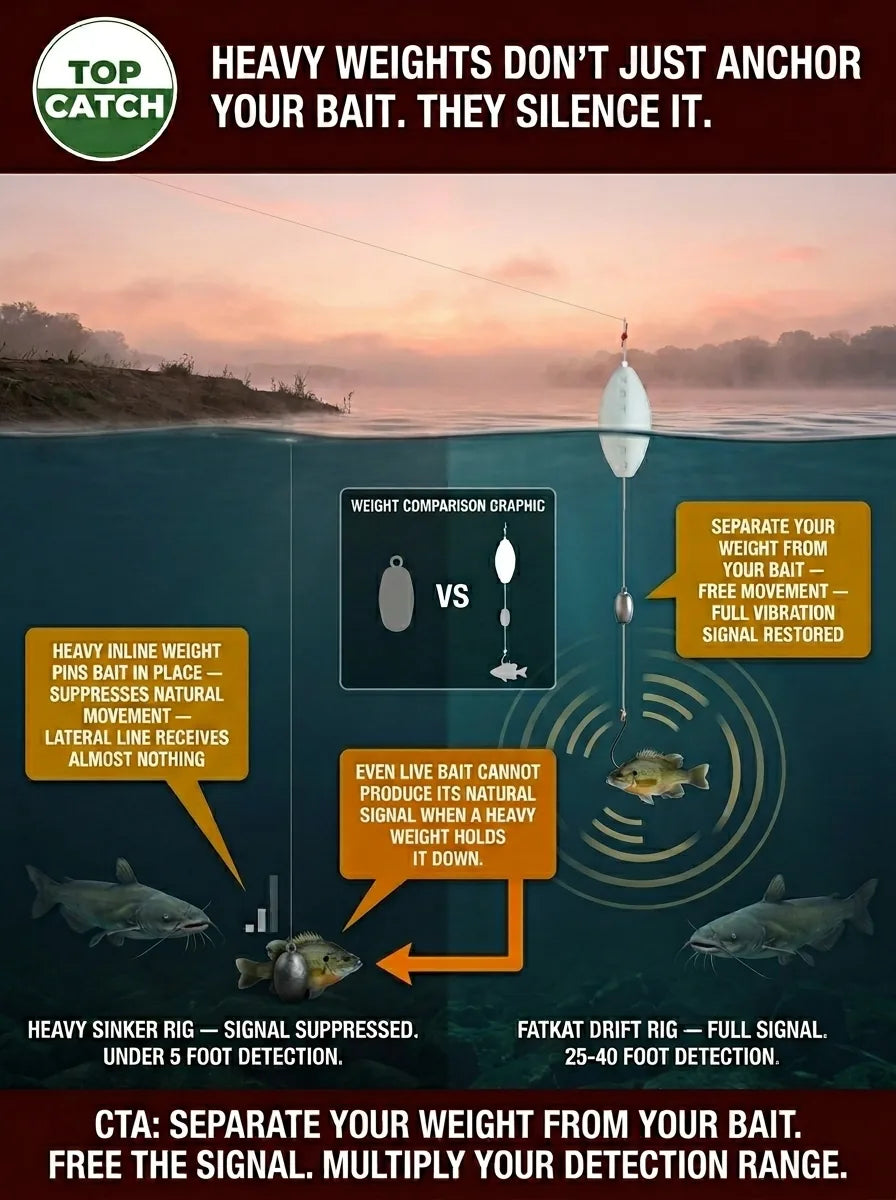
Bobber Rig vs. Bottom Rig for Catfish — A Direct Comparison
Every performance difference between a suspended drift rig and a bottom rig traces back to one physical fact: where the bait is in the water column.
That single variable — depth and suspension — determines how well catfish can detect your bait, how much water you cover per cast, and how often you're retying after a snag. Here's the complete side-by-side breakdown.
Full Technique Comparison Table: Scent, Vibration, Coverage, Snags, and Strike Rates
| Performance Factor | Bottom Rig | Suspended Drift Rig |
|---|---|---|
| Scent Dispersal | Bait contacts sediment — scent compounds bind to substrate rather than dissolving into the water column. Limited downstream scent trail." | Bait suspended in current — scent compounds dissolve directly into moving water, creating a downstream ribbon that reaches fish hundreds of feet away. |
| Vibration Signal | Riverbed dampens vibration transmission. Prey movement muffled by contact with substrate. Lateral line detection range reduced significantly. | Bait vibrates freely in water column — pressure waves radiate in all directions. Lateral line detection range maximized. Live bait vibration reaches fish across the full pool. |
| Visual Silhouette | Bait rests against dark substrate — no contrast, no silhouette. Catfish hunting upward see nothing. | Bait suspended against surface light — clear silhouette visible from below. Triggers visual strike response in murky water where scent and vibration already have fish oriented. |
| Snag Rate | Hook and sinker in contact with riverbed structure — constant snag risk on rocks, timber, debris. High retying frequency. | Hook and bait suspended above structure — glides over bottom debris without contact. Dramatically lower snag rate in structure-heavy water. |
| Depth Control | Fixed at bottom — no adjustment for water column position. | Bobber stopper adjustable in seconds — precise depth control for any water column situation. |
| Strike Detection | Felt through rod tip or seen as line movement — requires attention and experience to read correctly in current, especially with weights dampening the "strike" feel. | Visual float indication — immediate, visible, readable at long distance. Float orientation adds continuous depth feedback throughout drift. |
| Best Conditions | Cold water below 55°F, still water, precise structure targeting when fish are stationary, and location is known. | Moving water, active current, river fishing, bank fishing, warm season catfishing — the majority of catfish fishing situations. |

How to Set Up a Catfish Bobber Rig for Moving Water
A catfish bobber rig has five components that work as a system — and the way you configure them for moving water is different from a still-water setup. Depth, leader length, and float selection all change based on current speed, water depth, and target species. Get the configuration right once and it fishes itself for the rest of the session.
→ Component Setup, Depth Guide, and Current Speed Adjustments ▼
The Five Components of a Catfish Bobber Rig
- Main Line — 20–30 lb braided line recommended for bank casting. Braid has no stretch, which maximizes sensitivity and hookset speed on circle hooks. No memory means it comes off the reel cleanly on long casts.
- Bobber Stopper — Sliding knot on the main line above the float that sets your fishing depth. Slide up to fish deeper, slide down to fish shallower. Should hold position under cast pressure but adjust easily between casts with finger pressure.
- Float — Your depth control and strike detection system. In moving water, choose a float with an aerodynamic profile and internal weighting — a round foam bobber will drag sideways in current and pull bait out of the strike zone. The FATKAT's internally weighted design maintains upright stability in current and casts significantly farther from the bank.
- Sinker — Provides the weight needed to keep the rig vertical and the bait at depth against current pressure. In the FATKAT system, the inline steel sinker threads directly on the leader above the hook, acting as a keel that keeps the entire rig oriented correctly. Non-toxic steel keeps you legal on all regulated waters.
- Leader and Hook — The connection between your rig system and the fish. Leader length of 8–12 feet keeps bait well below the float's surface disturbance zone. An In-line circle hook at the end improves hookup rates and dramatically reduces gut-hooking on released fish.
Setting Depth for a Catfish Bobber in Moving Water
The correct starting depth for most river catfishing situations is mid-column — roughly half the total water depth. In a 10-foot run, start at 5 feet. In a 15-foot channel edge, start at 7–8 feet. Use float orientation as your depth feedback: if the float tips on the drift, you're touching bottom and need to shorten. If you're fishing a full drift without contact and without strikes, deepen by 6 inches and repeat until you find the strike zone.
| Current Speed | Depth Adjustment | Why |
|---|---|---|
| Slow (< 1 mph) | Fish mid-column to deeper | Fish holding lower in slow water |
| Moderate (1–3 mph) | Fish mid-column | Standard strike zone depth |
| Fast (3+ mph) | Fish shallower | Current pushes bait down — compensate up |
| Flooded/turbid | Fish shallower | Fish moved shallow into slack water |

How to Drift a Catfish Bobber Rig — Working the Strike Zone
Setting up the rig correctly is half the work. The other half is how you fish it. Drift fishing for catfish is an active technique — cast angle, seam selection, and float reading all determine whether your bait passes through the strike zone or beside it.
Once you understand how catfish find suspended bait and to read the water, one session on a river feels completely different from anything a bottom rig produces.
→ Cast Angle, Seam Reading, Current Strategy, and Working Structure Without a Boat ▼
Reading the Seam — Where to Aim Your Cast
A seam is the boundary between fast water and slow water in a river. It's where current speed changes — behind a boulder, at the edge of a channel, along a gravel bar, at the downstream end of a logjam. Catfish hold in the slow water side of the seam, facing upstream, and intercept prey carried to them by the current on the fast water side. Your target is the seam itself — the transition zone where fast water delivers food to waiting fish.
From the bank, identify seams by looking for:
- Surface texture changes — choppy water transitioning to smoother water
- Color changes — turbid main channel transitioning to clearer slack water
- Visible structure — logs, rocks, bridge pilings that create current breaks downstream
Cast slightly upstream of the seam entry and let the drift carry your bait through the transition zone. The strike almost always occurs at or just downstream of the seam — where the fish is holding.
Cast Angle and Drift Line
The cast angle determines your drift line — the path your bait travels through the water:
- Upstream cast (45° upstream): Bait drifts naturally downstream through the seam. Longest drift time in the strike zone. Best for covering a long seam in a single cast.
- Cross-current cast (90°): Bait swings across the current through the strike zone. Shorter drift but covers width rather than length. Good for wide, shallow seams.
- Downstream cast: Bait is pulled toward you by the current rather than drifting away. Creates unnatural presentation — avoid.
For most bank fishing situations, the upstream 45° cast is the most productive. It gives the current the longest possible time to carry your bait through the strike zone, and it presents bait moving toward fish that are facing upstream — which is the natural direction of prey approach.
Reading Float Orientation Throughout the Drift
A float with a defined vertical axis gives you continuous feedback on what the rig is doing below the surface:
- Float upright, tracking downstream: Bait is correctly suspended at depth in the strike zone. The rig is fishing. Watch for the dip.
- Float tipping forward (nose down): Faster current at depth than at surface — there's a current seam below. Your bait may be getting pushed out of position.
- Float tipping sideways: Cross-current catching the rig. Bait is drifting out of the seam. Adjust cast angle slightly upstream to correct.
- Float laying flat: Bait has contacted bottom. Shorten depth setting immediately.
Working Structure Without a Boat
Bank anglers have a structural advantage that boat anglers don't: access to shallow, snag-heavy shoreline habitat that boats can't safely approach. Submerged timber, riprap, and undercut banks adjacent to deep holes are where big flathead catfish stage before nightfall. Work these areas with a shortened leader (6–8 ft) and a precise cast that drops the float just above the structure entry. Let the drift carry it through.
For mid-river structure — channel edges, main current seams, deep bends — use the full 10-foot leader and the upstream 45° cast. Repeat the drift through the same seam 3–4 times before moving. If catfish are holding in that seam, they will respond to repeated presentations of naturally drifting bait.
Covering Water Systematically
Work a stretch of bank from upstream to downstream. Cast to the farthest reachable seam first, drift it through, retrieve, take two steps downstream, and repeat. This walking drift technique presents your bait to every catfish holding in a stretch of river without spooking fish with boat noise or repositioning. On a productive evening in good water, this method covers more fish-holding structure in one session than a boat anchored in multiple spots.
When to Use a Bobber vs. Bottom Rig for Catfish
The suspended drift rig wins in most catfish fishing situations — but not all of them. Current speed, water temperature, target species, and water type all influence which presentation gives you the best odds.
Here's the complete decision framework so you always have the right rig in the water for the conditions in front of you.
→ Current, Season, Species, and Water Type — The Complete Decision Guide ▼
Use a Suspended Drift Rig When:
- Water temperature is above 55°F — catfish are actively feeding and willing to move to intercept prey
- Detectable current is present — any river, tidal system, or moving water where drift is possible
- Targeting blue catfish — blues are active mid-column hunters that follow scent trails in current
- Targeting flathead catfish with live bait — flatheads ambush from structure and strike upward at passing prey
- Bank fishing — drift covers water that bank anglers can't reposition to reach
- Structure-heavy water — suspended presentation eliminates snag contact with bottom debris
- Active feeding periods — dawn, dusk, moving tide, post-rain events when fish are actively hunting
Use a Bottom Rig When:
- Water temperature is below 55°F — cold water slows metabolism, fish are less willing to chase suspended bait
- Targeting a precise, known holding spot — specific rock pile, channel ledge, or deep hole where fish are confirmed present and stationary
- Still water with no current — ponds, lakes, reservoirs where drift isn't available and mid-column suspension isn't carrying scent effectively
- Targeting channel catfish in ponds — channels in still water often feed near the bottom, particularly in warm months when they're foraging rather than actively hunting

Setting Depth for a Catfish Bobber in Tidal Waters
Tidal rivers change the drift equation every six hours. On the outgoing tide, fish hold at the downstream edge of structure and face the downstream current — your drift should go with the tide, presenting bait to fish facing that direction.
On the incoming tide, the reverse: fish shift to the upstream edge of structure and face the incoming current. Adjust your cast to drift with the current direction, not against it.
During slack tide — the 20–30 minute window when current stops before reversing — catfish often drop to near-bottom. This is the one moment on a tidal river when a bottom rig briefly has an edge.
| Season | Water Temp | Best Presentation | Target Depth |
|---|---|---|---|
| Early Spring (Mar–Apr) | 45–60°F | Slow drift or bottom near deep structure | Lower mid-column |
| Late Spring (Apr–May) | 60–70°F | Full suspended drift | Mid-column |
| Summer (Jun–Aug) | 70–85°F | Aggressive suspended drift — peak season | Mid to upper column at dawn/dusk |
| Early Fall (Sep–Oct) | 65–75°F | Suspended drift — second peak | Mid-column |
| Late Fall (Nov–Dec) | 50–60°F | Slow drift transitioning to bottom | Lower mid-column to bottom |
| Winter (Jan–Feb) | 35–50°F | Bottom rig in deepest available hole | Bottom |

Catfish Bobber FAQs
In moving water, yes — consistently and significantly. A bobber isn't just a strike indicator for catfish fishing; it's a depth control system that keeps your bait in the mid-column strike zone where catfish actively hunt.
Bottom rigs work in specific cold-water and still-water situations, but the majority of productive river catfishing hours call for a suspended presentation.
If you're fishing a river or tidal system with detectable current and water above 55°F, a properly set drift rig will outperform a bottom rig in virtually every scenario.
A catfish bobber rig is a float-based presentation system with five components: main line, bobber stopper, float, sinker, and a leader with a circle hook.
The bobber stopper sets exact depth, the float suspends bait in the water column, and the sinker keeps the rig vertical and stable in current. In moving water, the current drifts the entire rig naturally through the strike zone — covering 30–50 feet of productive water per cast without reeling in. It's the foundation of the suspended drift technique.
Start with your bobber stopper on the main line, thread on your float, then attach a leader of 8–12 feet with a sinker and circle hook.
Set initial depth at mid-column — roughly half the total water depth. Cast upstream of your target seam and watch float orientation: upright means correctly suspended, tipped means bottom contact. Adjust the stopper up or down in 6-inch increments until the float stays upright through the full drift without touching bottom. That depth is your strike zone — lock it in and fish it.
In moving water, bobber fishing consistently outperforms bottom fishing for three compounding reasons.
First, scent: suspended bait releases amino acids into the water column rather than binding them to sediment — producing a downstream scent trail catfish can track from hundreds of feet away. Second, vibration: bait vibrating freely in the water column broadcasts lateral line signals that sediment-contact bait cannot. Third, coverage: a drifting catfish bobber rig covers 10–20 times more productive water per cast than a stationary bottom rig. Cold water below 55°F is the one condition where bottom fishing closes the gap.
Yes — but float selection determines whether it works or fails. Round foam bobbers get pushed sideways and under in fast current, dragging bait below the strike zone and eliminating depth control.
An aerodynamic, internally weighted catfish bobber, like the FATKAT bobber, maintains upright stability in fast current because its profile cuts through water rather than catching it. Fast water is actually where the catfish bobber rig has its biggest advantage over bottom rigs — current actively carries your bait through the strike zone rather than fighting against your presentation.
For river catfishing, the best catfish bobber is one that casts far enough to reach mid-river seams, holds upright stability in current, and is buoyant enough to suspend heavy live bait or cut bait with a sinker.
The FATKAT checks all three — its internally weighted design and aerodynamic shape cast farther than traditional round floats, and its buoyancy chamber handles the combined weight of large live bait and steel sinker in fast current. For still water or light current with small bait, a standard weighted slip float is a reasonable alternative.
Start at mid-column — half the total water depth. In a 10-foot run, set the bobber stopper at 5 feet. In a 15-foot channel edge, start at 7–8 feet.
Use float orientation as your real-time feedback: if the float tips on the drift you're touching bottom and need to shorten; if you complete full drifts without contact or strikes, deepen by 6 inches. Fast current pushes bait down — compensate by setting slightly shallower than mid-column. Flooded shallow water calls for 4–6 feet regardless of total depth.
Significantly. Bottom rigs in structure-heavy river water — the most productive catfish habitat — snag on rocks, submerged timber, riprap, and debris with regularity.
ach snag costs tackle and retying time. A suspended drift rig carries the hook 3–10 feet above the riverbed throughout the drift, clearing the structure that bottom rigs catch on. In a three-hour session on a snag-heavy river, the difference in retying frequency between a bottom rig and a drift rig can recover 30 minutes of actual fishing time. That recovered time, compounded across a season, is a meaningful number of additional productive casts.
Significantly. A catfish bobber rig suspends the hook 3–10 feet above the riverbed throughout the entire drift — clearing the rocks, timber, riprap, and debris that bottom rigs catch on constantly in productive catfish water. In a three-hour session on a snag-heavy river, the difference in retying frequency can recover 30–45 minutes of actual fishing time. That recovered time compounded across a full season is hundreds of additional productive casts in the water rather than spent rebuilding rigs on the bank.
For bank fishing, the best drift rig for catfish needs to clear two bars a boat angler doesn't face: casting distance to reach mid-river seams, and drift coverage to compensate for the inability to reposition.
The FATKAT's internally weighted float casts farther and straighter than round bobbers from the bank, reaching seams most bank anglers can't access. Once it lands, the drift carries bait through 30–50 feet of strike zone per cast — covering water that would require a boat angler to anchor, fish, reposition, and repeat.
Yes — some of the largest catfish caught from Mid-Atlantic tidal rivers have come while drift fishing for catfish from the bank with large live bait presentations.
The key for big fish is matching float buoyancy to bait size: a 5–7 inch live bluegill combined with a steel sinker in fast current needs a float rated for that combined weight.
The FATKAT's buoyancy chamber is specifically sized for that presentation — it stays upright and strike-sensitive under the load rather than riding low or submerging. Big catfish are active predators. A naturally drifting, suspended bait presentation is exactly what triggers them.
Use a catfish bobber rig whenever water temperature is above 55°F and current is present — which covers the vast majority of productive river catfishing conditions from April through November.
Switch to a bottom rig when water drops below 55°F and fish have moved to deep stationary holds, where targeting a precise structure spot in still water, or during slack tide windows on tidal rivers when current stops completely.
The catfish bobber rig wins in active conditions and also works in cold water where you are not sure of the location of the fish, and you need to slowly, slowly drift bait across an area and bring the bait to the fish.
The bottom rig covers the narrow cold-water, still-water scenarios where fish location is known so you can land the rig exactly where the fish are located, because once it is there, if there are no fish there, you will have trouble with the bite, as amino acids do not dissipate the same in cold water. .

Stop Waiting. Start Hunting.
Bottom fishing is passive — you put bait somewhere and hope a fish finds it. Suspended drift fishing is active — you take the bait to the fish, through their strike zone, broadcasting every signal they hunt by.
The technique is the difference. The FATKAT bobber is a catfish bobber rig that makes it work.
Proven Techniques to Master Catfish Bobber Fishing

Float Selection
Best Catfish Bobber for 2026
The drift technique is only as good as the float running it. See how the FATKAT's aerodynamic design and internal weighting make the technique possible from the bank.
Full Rig
Best Catfish Rig for 2026
The suspended drift rig ranked #1 out of five major catfish rig designs. See the full comparison and the biology behind why it wins.
Bank Fishing
Bank Drift Fishing for Catfish. No boat required.
Learn how to read seams, reach mid-river structure, and work the drift from the shore on any river system.
REFERENCES & FURTHER READING
- U.S. Fish & Wildlife Service — Catfish Management & Behavior |
https://www.fws.gov/story/catfish-management - Virginia Department of Wildlife Resources — Catfish Species Profiles |
https://dwr.virginia.gov/fishing/catfish/ - American Fisheries Society — Lateral Line System & Sensory Research |
https://fisheries.org/2022/04/fish-sensory-systems-overview/ - Journal of Freshwater Ecology — Catfish Olfactory Research Summary | ttps://www.tandfonline.com/loi/tjfe20
- NOAA Fisheries — Habitat Conservation & Benthic Protection |
https://www.fisheries.noaa.gov/habitat-conservation - Wisconsin DNR — Catfish Biology & Behavior |
https://dnr.wisconsin.gov/topic/Fishing/species/catfish.html - Missouri Department of Conservation — Catfish Fishing & Habitat Guide |
https://mdc.mo.gov/fishing/species/catfish