

The Rig Built for This Kind of Fishing
-
FATKAT Rig — Pre-Tied Catfish Drift Rig for Lakes, Rivers & Bank Fishing
Regular price $35.99Regular price$42.99Sale price $35.99Sale -
FATKAT Bobber — Large Catfish Bobber for Long Casts, No Foam
Regular price $27.99Regular price$34.99Sale price $27.99Sale


Built For The Angler Who Goes Anywhere To Find The Fish
You know that spot.
The one nobody else bothers with because the bank is overgrown, the rocks are slick, and getting there means pushing through a quarter mile of poison ivy and wading through waist deep water, with a rod over your shoulder.
You found it anyway — because that's what bank anglers do.
▼ Why Bank Anglers Are The Most Dangerous Fishermen On The River ▼
Boat anglers have motors, sonar, rod holders, and comfortable chairs. What they don't have is the willingness to bleed for a fishing spot.
Bank anglers wade into places with no name on any map. They climb down embankments in the dark, set up on rocks that require both hands to reach, fish water that hasn't seen a hook in years — and they do it carrying everything they need on their back because there's no dock to tie up to and no motor to go back for forgotten gear.
That obsession is exactly what FATKAT was built around.
Not because bank anglers need help finding the spots. But because once you're standing on that perfect rock above the perfect seam, the gear in your hand should be worthy of the effort it took to get there.
The FATKAT drift rig gives experienced bank anglers one thing they've never had: the ability to fish the entire river from that rock. Not just the water in front of you — the channel, the seam, the prop-killer rapids the boats actively avoid. All of it. From the bank. Without moving an inch.
And for those looking to get started with catfishing, it is most important item to a complete catfish rig setup for beginners that will get you started and keep you hooked on catfishing.
You found the spot. Now fish all of it.
How to catch more catfish from the bank? The Shoreline Trolling Method
Professional fishing guides don't sit still. They use trolling motors to move bait at 0.5 to 1.1 mph because data shows that "Hunting" finds more fish than "Waiting." Most bank anglers are still stuck using bottom rigs, effectively fishing in a 5-square-foot box. We’ve changed that.
Shoreline Trolling: Drifting bait through productive water from a fixed bank position — mimics what trolling motors do for boat anglers, without the boat.
Why professional "Trolling" logic beats the standard bottom rig ▼
When a pro guide "controlled drifts," they are maximizing their Hydrodynamic Sampling Rate —meaning they are putting bait in front of as many fish as possible.
By using a FATKAT Drift Rig, you are performing Shoreline Trolling. You use the river's current to "troll" your bait across miles of water. This creates a Scent Highway and a Vibration Beacon that triggers a catfish's lateral line, forcing them to pay attention to your bait. You are using the physics of the river to do the work of a $3,000 trolling motor.


How to Cast Farther for Catfish from the Bank — Without Losing Control of Your Drift
To compete with a boat, you have to reach the center-channel. Once you've moved away from static bottom rigs with heavy lead weights, most float rigs fail to cast far because they are "disjointed"—the float and the sinker fight each other in the air, creating a "Parachute Effect" that kills your distance.
How our Unified Inline Design creates a single moving force ▼
The FATKAT Drift Rig isn't just a float; it’s a unified projectile. By integrating the weight into a Unified Inline Design
(the aerodynamic weight-forward design that gives the FATKAT its casting distance advantage over conventional round bobbers), which is one reason why it is the best catfish rig for rivers. We’ve eliminated casting chaos and air friction.
- The Ogive Shape: The jet-nose profile slices through the wind instead of catching it.
- Unified Momentum: Because the float carries weight, the entire rig moves as a single Moving Force Instead of the sinker pulling a dragging float, the rig works together to punch through the air.
- The Result: You gain 40-60% more distance, allowing you to cross the "Boater's Line" and land in the deep-water seams that were previously unreachable from shore.
What is the best bank fishing rig for rapids? Unreachable Hole Dominance
Reaching the channel is just the beginning. The FATKAT Drift Rig gives you a physical advantage over the boats: you aren't afraid of the rocks.
While boaters stay in the "safe" water to protect their propellers, you can hunt the "Prop-Killer" spots they can't touch. These are often the most productive fishing holes for ambush predators like catfish.
Why the FATKAT Drift Rig dominates where boats can't go ▼
Boats are restricted by propellers and draft depth. They literally cannot enter shallow rock gardens or high-velocity "boil holes" at the base of rapids without risking thousands in damages.
The FATKAT Drift Rig has no moving parts to break. This is Unreachable Hole Dominance. It allows active anglers to hunt the rock-choked seams where the biggest Blue catfish and Flatheads hide. While the boats are stuck in the "boring" main channel, you are taking the best water on the river for yourself.


Why Bank Anglers Can Reach Catfish That Boat Anglers Never Will
A boat has to float. That one constraint eliminates more productive catfish water than most anglers realize.
Every rapid, every rocky shoal, every shallow flat above a drop — boats avoid all of it. Bank anglers don't.
▼ The Water Boats Avoid Is The Water Catfish Love ▼
Catfish are ambush predators. They don't hold in open, navigable water — they hold in the complex, snaggy, difficult water that makes boat operation dangerous. Bridge pilings with rip-rap. Rocky tailraces below dams. Shallow rocky flats above deep holes. Flooded timber in high water.
A trolling boat has to navigate around all of these. A bank angler with a drift rig doesn't navigate around them — they cast into them. The FATKAT's suspended presentation clears the snags that make this water impossible to fish with a bottom rig, and its casting distance puts bait into the middle of structure that no boat can approach without risking the propeller.
The water boats avoid isn't unfishable. It's just unfishable by boats.
How to Detect Catfish Bites from the Bank Without Electronics
You don't need a digital screen to see what’s happening in the Predator's Lair.
Because the FATKAT bobber isn't just a round ball, its position tells a story about the river bottom. This is another reason why it is the best float for bank catfish fishing.
Read more ▼
How to Read the FATKAT's Sonar Clues
- Lying Flat: If your float is on its side, your weight is on the bottom. You are in shallow water.
- Standing Tall: When the float stands up, your bait is perfectly suspended in the strike zone.
- Bobber Down: The FATKAT is Ogive shaped (like a jet nose). This shape slices into the water with almost zero resistance. On a traditional rig, a fish might feel the "tug" of a bulky bobber and spit the hook. With the FATKAT, they feel nothing but a natural snack until the hook is set.


How to Stop Snagging: The Triple Play for Bank Anglers
Losing gear to debris is a waste of money and time (we call this the "Retying Tax") and a threat to the water.
Anglers understand there is a bobber fishing technique for catfish that just catches more fish while keep gear on the line.
The FATKAT rig is engineered to float above debris, keeping your line in the water and the river lead-free.
Read more ▼
Sustainable Fishing Gear
To Protect the Ecology, we replaced lead with Precision Steel Weights. If you do get snagged in deep timber, you aren't leaving toxins behind because our gear is made from eco-friendly materials.
Our Triple Play ensures that: (1) You save money by not losing gear, (2) the eco-friendly bobber keeps the water clean for future generations, and (3) you spend your time hunting fish instead of retying your line.
How Drift Fishing Triggers More Catfish Strikes Than Bottom Rigs
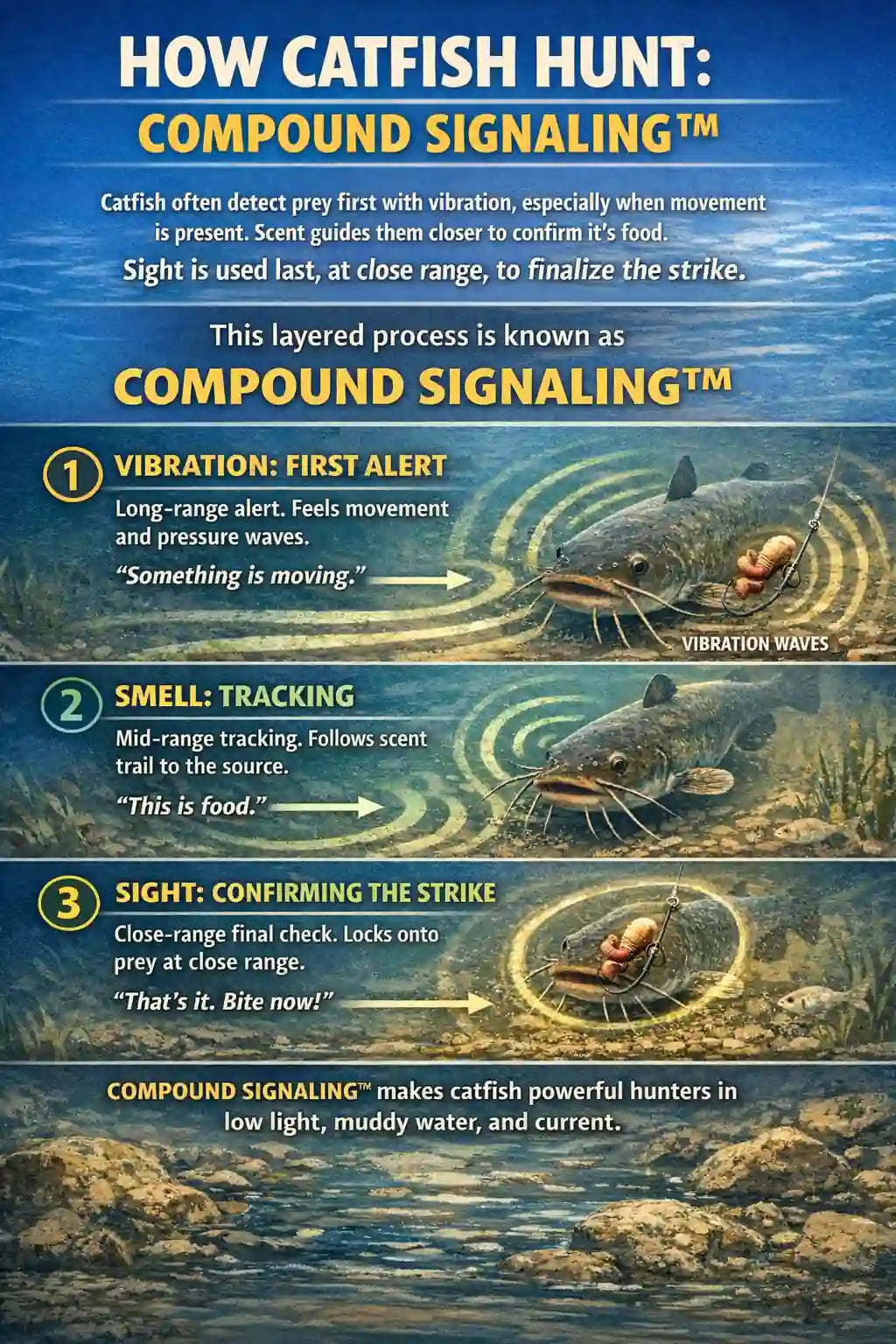
Most fishing rigs hide your bait's signal on the bottom. The FATKAT system Weaponizes "Compound Signaling" to turn your bait into a high-powered beacon that forces trophy catfish out of the Predator's Lair.
Read more ▼
Compound Signaling™ Explained
To Master the Biology of the river, you have to turn your bait into a hunter's tool.
- The Beacon (Vibration): Our rig is suspended, so your bait's vibrations are broadcast in 360 degrees. It’s like a "dinner bell" ringing through the water.
- The Highway (Scent): As your bait drifts, it "paints a road" of scent. This Scent Highway gives the fish a map to follow directly to your hook.
- The Silhouette (Sight): When the fish looks up, it sees a dark shape against the light. This visual trigger closes the deal.
Watch: Bank Drift Fishing for Catfish from the Shore
![Video thumbnail for How To Catch Big Catfish From The Bank: Catching Catfish In Rivers [HUGE!] | SFSC - YouTube](https://img.youtube.com/vi/EOllEGVXrG8/maxresdefault.jpg)
The Tactical Advantage: Boat vs. Bank
Stop settling for the "scraps" near the shore. Use this comparison to see how the FATKAT Drift Rig puts the power back in the hands of the bank fisherman.
| performance Metric | The Boat Angler | The FATKAT DRIFT RIG | The Winner |
|---|---|---|---|
| Strategy | Trolling the River | Drifting in the Seam (Shoreline Trolling) | Slight Advantage to Boat |
| Targeted Casting | Vertical drop from deck | Unified Inline Force | FATKAT Drift Rig |
| Rapid/Rock Access | Avoids them. (Prop damage). | Unreachable Hole Dominance. | FATKAT Drift Rig |
| Angler Engagement | Passive Waiting | Active. Movement. Positioning. | BANK |

How to Set Up Your Catfish Drift Rig: Step-by-Step Bank Fishing for Catfish Setup
Proper drift rig setup ensures bait stays at strike depth and drifts smoothly.
Follow these steps to optimize scent, vibration, and visual cues for catfish, or stop by our "How To" page for basics and more advanced techniques.
Read more ▼
5 Steps to Weaponize Your Rig
- Tie the Rig: Attach your FATKAT rig to your leader.
- Set the Ceiling: Adjust your bobber stop so the bait hangs 1–2 feet above the bottom.
- The Launch: Cast upstream or across the current using the "Rocket" technique.
- Watch the Sonar: Monitor your float for visual clues (Standing Tall = Fishing; Lying Flat = Snagged/Bottom).
- The Strike: When the "Bobber Down" signal happens, prepare for the attack sequence!
- Set the hook: When the bobber has been under and the fish has committed, slowing remove the slack from the line and set the hook..
Bank Catfishing Tips: How to Read the River Without Being On It
Boat anglers use sonar to read the river bottom. Bank anglers use the water surface — and once you know what to look for, it's just as reliable. Current breaks, foam lines, color changes, and eddy pockets tell you everything you need to know about what's underneath.
Five Surface Signals That Tell You Where Catfish Are Holding ▼
The Foam Line — Foam collects at current seams where fast and slow water meet. This is where catfish stage waiting for bait to drift past. Cast to the edge of the foam, not through it.
The Color Change — Where murky water meets clearer water, baitfish concentrate. Catfish follow the baitfish. This color boundary is your first cast of the day.
The Calm Pocket Behind Structure — Any rock, log, or bridge piling creates a downstream calm zone. This is where catfish rest out of the current and ambush anything drifting past.
The Depth Drop — Where shallow water suddenly deepens, catfish hold on the ledge. You can often see this as a color darkening in the water. Your drift rig should be set to reach the bottom of that drop.
The Eddy — Circular current behind structure collects food naturally. Catfish know this. A drift rig circling an eddy is one of the most productive bank presentations available.
Once you've identified the right seam, the best catfish rig for river fishing is one that can reach it from the bank and stay in it — which is why the drift presentation consistently outperforms bottom rigs in moving water.

Bank Fishing for Catfish: How the FATKAT Solves Every Problem Bottom Rigs Create
Solving Bank Fishing Challenges
We compared traditional bank fishing problems to the FATKAT solutions. Use this table to understand how we use Compound Signaling and the Triple Play method to help you catch more fish from the shore.
| Mission Variable | The Bank Fishing Challenge | The FATKAT Solution | Why it Wins |
|---|---|---|---|
| Casting Range | Rigs act like a Parachute, falling short of the channel. | The Rocket Design: Inline weighted architecture. | Pierces the wind to reach deep-water Feeding Lanes. |
| Bite Detection | "Blind" fishing; can't see or feel subtle nibbles. | Visual Sonar: Ogive-shaped signaling float. | Tells you if you are deep, shallow, or if it's "Bobber Down" time. |
| Snag Prevention | The "River Tax": Losing gear in rocks and logs. | The Triple Play: "Ceiling and Keel" suspension. | Saves your wallet, protects the water, and keeps you fishing. |
| Current Drag | Current washes bait out of the strike zone. | Steel Weighted Keel: Hydrodynamic stabilizer. | Keeps bait vertical and natural in high-flow river sections. |
| Fish Attraction | Passive waiting for fish to find hidden bait. | Compound Signaling™: Active Drift Hunting. | Broadcasts a Vibration Beacon and Scent Highway in 360°. |
| Sustainability | Leaving lead and plastic in the Predator's Lair. | Eco-Friendly Materials: Lead-free steel weights. | Protects the Ecology while you Master the Biology. |

FAQs for Bank Drift Fishing
The best catfish rig for bank fishing is one that solves the three problems bank anglers face that boat anglers don't: casting distance to reach the channel, snag resistance in rocky water boats avoid, and bite detection at long range without sonar.
A suspended drift rig addresses all three simultaneously. The FATKAT drift rig was built specifically around these constraints — its inline weight-forward architecture casts farther than conventional float rigs, its suspended presentation clears rocks and debris boats actively avoid, and its ogive float shape signals bites visually at distances where traditional bobbers become invisible. For bank anglers targeting catfish in moving water, a properly calibrated drift rig consistently outperforms bottom rigs because it puts bait where catfish actually feed — suspended above structure in the current — rather than buried in the debris where catfish aren't looking.
In a river, the best catfish rig is one that works with the current, not against it. Current changes everything about how catfish find food — it carries scent downstream in long trackable plumes, it positions catfish in current seams rather than on the flat bottom, and it creates the natural drift movement that triggers lateral line detection from a distance.
A bottom rig in a river anchors bait in one spot while the scent trail, vibration signal, and visual silhouette all get suppressed by contact with the riverbed. The current delivers nothing to the fish because the bait is buried in mud or wedged against rock. A suspended drift rig puts bait directly in the moving water column where the current does the work — carrying scent downstream, creating natural movement, and holding bait at the depth where river catfish are actually positioned.
The FATKAT drift rig was built specifically for river conditions: the steel inline sinker stabilizes the rig in current rather than dragging sideways, the weighted ogive float reaches mid-channel from the bank, and the suspended presentation keeps bait in the seam where blue catfish, flatheads, and channels are actively hunting. For river fishing — from the bank or anywhere else — a properly calibrated drift rig consistently outperforms bottom rigs because it puts bait where the fish are, not where the current pushes it.
Standard slip floats are a drag. They create friction on the line and drag in the air.
An Inline Drift Rig like the FATKAT integrates the weight into the float's architecture, creating a unified force with the inline sinker and the bait on the hook, that casts farther, allows you to target landing areas, and tracks straighter in heavy current.
Stop using bulky, plastic and Styrofoam bobbers that act like parachutes. Switch to a weighted, inline float like the FATKAT. Its rocket-shaped weighted design cuts through wind and adds major distance to every cast.
Bottom fishing is passive waiting. Drift fishing is Active Hunting.
A drifting bait covers miles of water, broadcasting vibrations in 360 degrees and bringing the Scent Highway directly to the fish instead of waiting for them to find you.
Absolutely. While Blue Catfish often hold in the "shadows" of rocks and ledges to ambush prey, they are highly attuned to the current seams.
By drifting your bait, you are delivering your bait directly into the ambush zones. It is the most effective way to "knock on their door" rather than waiting for them to leave their cover.
Yes, because the FATKAT rig acts like a Broadcast Tower for your bait. It works in three steps:
- The SOS Signal: First and foremost, the vibrations of a struggling live bait are the #1 trigger for a catfish.
- The Bell Effect: While traditional weights sit on the bottom and "muffle" those vibrations in the mud, our rig stays suspended. This allows the bait's natural signals to ring out clearly through the water like a bell in the air.
- The Vortex Beacon: As the river current hits the solid Steel inline sinker, it creates a low-frequency pulse. This "Secret Signal" mimics the wake of a swimming fish, drawing predators out of the Predator’s Lair and into your Feeding Lane.
Absolutely. Catfish usually look up to hunt. A bait sitting in the mud is hidden. A suspended bait creates a sharp, dark silhouette against the surface light, triggering a visual "Attack Sequence."
The FATKAT system uses Compound Signaling™. It combines the scent plume, the vibration pulse, and the visual silhouette into one perfect presentation that catfish can't ignore in their Primary Strike Zone.
Flatheads are apex predators that love movement. They "feel" the vibration of a drifting bait long before they smell it. The FATKAT drift mimics a struggling fish moving through their Hunting Grounds.
In "chocolate milk" water, fish rely 100% on vibration and scent. Because your rig is suspended and moving, it pumps out a much stronger signal than a bait buried in the silt on the bottom.
Yes, because it triggers a reflex. When a predator sees a "meal" drifting by in the current, they have to commit quickly or lose it. This creates a much more aggressive strike.

CONCLUSION
Drifting bait from the bank is the most effective way to catch catfish. If you rely only on bottom rigs from the bank, you are limiting how many catfish ever find your bait.
The FATKAT rig is designed to disperse scent, broadcast vibration, and ensure bait is positioned where catfish can leverage their visual skills for maximum strikes.
Read more ▼
- Master the technique, location, and bait choice
- FATKAT rig ensures consistent Compound Signalling™
- Trophy catfish are within reach from the shore with proper setup
SPECIES SENSORY BIOLOGY
Flathead Sensory Guide
Learn how flatheads use scent, vibration, and silhouette to track drifting prey — and why suspended bait produces the strongest strike triggers.
CATFISH BAIT SCIENCE
Best Baits for Drift Fishing
See which live and cut baits create the strongest scent trails, vibration signatures, and silhouettes for bank drift fishing.
ADVANCED CATFISH TECHNIQUES
Catfish Rigs & Techniques
Explore more bank fishing rigs, scent-drift strategies, and vibration-based presentations to master big-cat tactics.
REFERENCES & FURTHER READING
- Bleckmann, H. (2006). The Lateral Line System of Fish. |
https://www.sciencedirect.com/science/article/abs/pii/S1546509806250106 - Mogdans, J. (2019). Sensory Ecology of the Fish Lateral-Line System. |
https://pubmed.ncbi.nlm.nih.gov/30873616 - Montgomery, J. et al. (2017). Functional Diversity of the Lateral Line System Among Freshwater Fishes. |
https://journals.biologists.com/jeb/article/220/12/2265/34094 - Bleckmann, H., & Mogdans, J. (2022). Processing of Hydrodynamic Stimuli With the Fish Lateral Line. Oxford Research Encyclopedia of Neuroscience. |
https://oxfordre.com/neuroscience/display/10.1093/acrefore/9780190264086.001.0001/acrefore-9780190264086-e-318 - Colvert, B., & Kanso, E. (2016). Fishlike Rheotaxis. |
https://arxiv.org/abs/1602.08537 - Bleckmann, H., Mogdans, J., & Coombs, S. (2014). Neurobiology of the Fish Lateral Line: Adaptations for Detecting Hydrodynamic Stimuli in Running Water. |
https://www.researchgate.net/publication/285131314_Neurobiology_of_the_fish_lateral_line_Adaptations_for_the_detection_of_hydrodynamic_stimuli_in_running_water