
How Catfish Find Bait: Three Senses, One Strike
Catfish don't find your bait by accident.
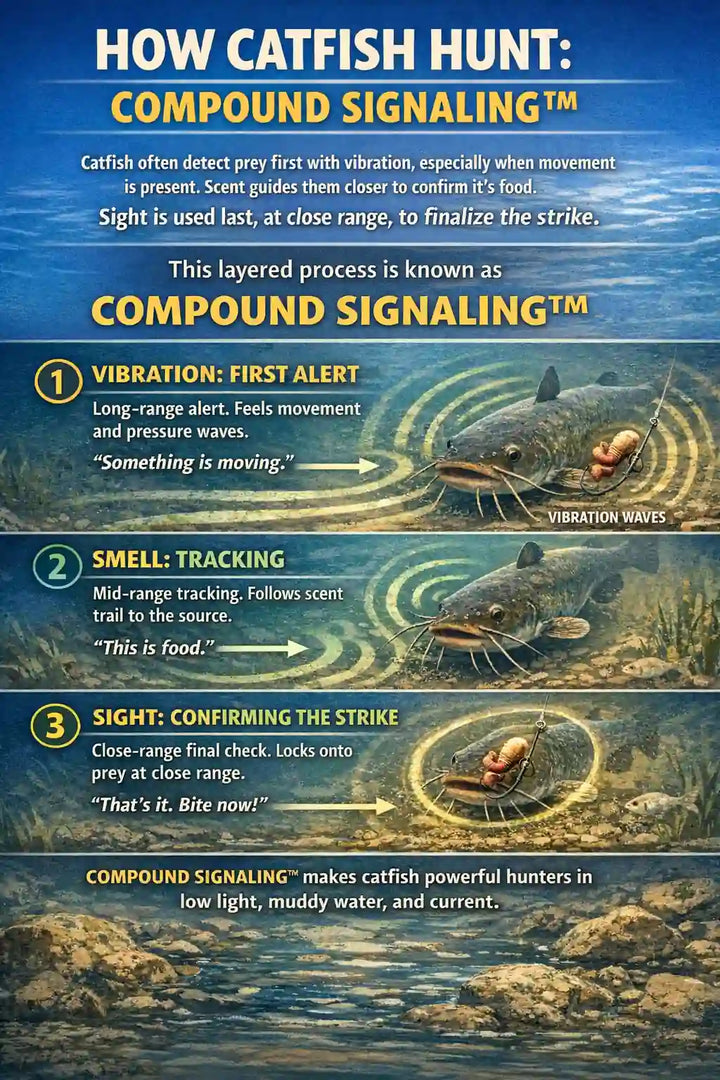
They have three built-in tools that work like a team. First they feel your bait moving in the water. Then they smell it and follow the trail. Then they see it right before they bite.
If your bait is sitting on the bottom, all three tools stop working. The bait doesn't move. The smell gets trapped in the mud. And there is no shape to see.
That is why how you present your bait matters as much as what bait you use.
Key Takeaways
Why do catfish sitting 5 feet from your bait sometimes never find it — while the same bait suspended above them gets struck almost immediately?
Because all three of their detection systems stop working when bait touches the bottom.
- The mud soaks up the smell before it can travel.
- The vibration goes into the ground instead of the water.
- And a bait sitting in the dark riverbed has no shape for the fish to see.
Lift the bait off the bottom and all three systems turn back on at once — the smell travels downstream, the movement sends signals through the water, and the bait becomes a visible shape the fish can lock onto.
Why do the three catfish senses fire in a specific order — and what happens to your strike rate when even one of them is missing?
- Vibration travels the fastest and fires first — a catfish 30 feet away feels your bait before it smells it.
- Scent fires second and acts like a GPS, guiding the fish closer.
- Sight fires last and triggers the final strike at close range.
Take away any one of those three signals and the chain breaks. No vibration means the fish never starts moving toward your bait. No scent means it can't navigate the final distance. No silhouette means it doesn't commit to the strike. All three need to be working at the same time. The rig that activates all three catfish senses is the one that is going to land more fish.
Why does the same bait that catches blues in one spot and channels in another fail to produce flatheads in the same river — even when all three species are present?
Because each species relies on a different sense first.
Blue catfish follow scent trails — they are scent-first hunters who track amino acid plumes in current.
Channel catfish are also scent-driven but respond to a wider range of chemical signals.
Flatheads are vibration-first hunters — their lateral line is so dominant that dead bait barely registers to their primary detection system. Same river, same bait, three completely different biological reasons for why it works on two species and fails on one.

Why a Catfish That Can't See Your Bait Still Finds It — Feeling Comes First
Catfish have a hidden sense that most anglers never think about. It is called the lateral line. It runs along both sides of the fish's body from its tail to its head. It feels water moving. Understanding how catfish feel vibration with their lateral line is extremely important in helping to understand rig and bait selection.
A catfish can feel your bait up to 40 feet away — in total darkness, in muddy water, with its eyes closed. That is the first signal it detects. Everything else comes after.
→ How the Lateral Line Works — And Why Bottom Bait Goes Silent to It ▼
What the Lateral Line Does
Think of the lateral line like a hearing aid for water movement. It has tiny sensors all along the fish's body. Each sensor is a small cup filled with jelly. When water moves, the jelly bends. When the jelly bends, the fish's brain gets a signal.
That signal tells the catfish:
- Something moved in the water
- Which direction it came from
- How far away it is
- Whether it's the kind of movement that means food
What Your Bait Needs to Do
A live bluegill struggling on a hook sends out strong water movement signals. So does a piece of cut bait drifting naturally in current. Both of these create the kind of water movement that catfish feel from a long distance.
A piece of bait sitting still on the bottom sends almost no signal at all. The ground absorbs the movement before it can travel through the water. A catfish 10 feet away might not feel it at all.
The Numbers
Bait suspended in open water: catfish can feel it from up to 30–40 feet away.
Bait sitting on a mud bottom: catfish might not feel it until they are 3–5 feet away.
Same bait. Same water. The only difference is where the bait is in the water column.
Want the full science on catfish vibration detection?
Why the Smell of Your Bait Can Travel 300 Feet — But Only If It Gets Off the Bottom
Catfish have a nose that is 1,000 times more powerful than a human nose. They can smell tiny bits of food dissolved in the water. In a river, the current carries that smell downstream like a ribbon.
Every wondered how catfish track scent trails in current. A catfish smells that ribbon and follows it straight to your bait — from up to 300 feet away.
But if your bait is buried in river mud, the smell never gets into the water. The ribbon never forms. The catfish never finds it.
→ How the Scent Trail Forms — And What Kills It Before It Reaches the Fish ▼
How Smell Works Underwater
Catfish smell through two small holes near their nose called nares. Water flows through these holes constantly. The catfish tastes the chemicals dissolved in that water. When it detects the right chemicals — the ones that mean food — it starts moving toward where the smell is strongest.
In a river, the current carries those chemicals downstream. The trail gets stronger as the catfish swims upstream toward the bait. It is like following a trail of breadcrumbs — except the breadcrumbs are invisible chemicals in the water.
What the Mud Does to the Smell
When bait sits on the river bottom, the mud and sand soak up the chemicals before they can get into the water. The smell stays trapped near the bait. It only spreads a few inches in any direction.
A catfish holding 50 feet downstream may never detect any smell at all — even if the bait is there. The trail never reached it.
What Suspension Does
When bait is lifted off the bottom and held in the current, the chemicals release directly into the moving water. The current picks them up right away and carries them downstream. A catfish 200 feet away can start following that trail within minutes of your cast.
Same bait. Same river. The only difference is whether the bait is in the mud or in the current.
Want the full science on catfish scent detection?
→ CATFISH SENSE OF SMELL GUIDE


Why a Catfish That Has Already Found Your Bait Sometimes Turns Away at the Last Second
The catfish felt your bait. It followed the smell. It swam right up to the hook. And then it turned away without biting. This happens more than most anglers realize — and it almost always comes down to the third sense: sight. Understanding how catfish see bait in low light will change how you fish.
At close range, a catfish looks up toward the surface light to see the shape of its prey. If the bait is on the bottom, there is no shape to see. And if something about the bait looks or feels wrong, the fish walks away.
→ How Catfish Use Vision at Close Range — And What Makes Them Turn Away Before the Strike ▼
How Catfish Eyes Are Built
Catfish eyes point slightly upward. This is not an accident. Catfish are built to look up at their prey. They attack from below, looking up at the shape of a fish or bait against the lighter water above.
When bait is suspended in the water column, it creates a dark shape against the lighter water above it. That shape is what the catfish is looking for. It is the final signal before the strike.
When bait is on the bottom, it sits against dark mud or sand. There is no contrast. There is no shape. The catfish's eyes find nothing to lock onto.
Why Catfish Sometimes Turn Away
At the last second, the catfish does a quick check. It gets very close to the bait and feels it with its lips and whiskers. If something feels wrong — a piece of metal, a chemical smell it does not recognize, bait that has gone stale — it drops the bait and leaves.
This is why fresh bait matters. This is why steel sinkers matter instead of lead. This is why keeping the skin on cut bait matters. Every one of those choices removes a warning signal that could cause the fish to walk away at the last second.
Want the full science on catfish vision?
→ CATFISH VISION BIOLOGY GUIDE

How All Three Senses Work Together — And Why Bottom Rigs Break the Chain
The three senses do not work on their own. They work as a team. One starts the process. The next one narrows it down. The third one finishes it.
When all three are working, a catfish can find bait from hundreds of feet away and strike with precision. When even one of them is broken, the whole chain fails.
A bottom rig breaks all three at the same time.
→ The Three-Step Strike Sequence — And Where Bottom Rigs Break It ▼
Step 1 — Feeling (Long Range)
The catfish feels water movement from up to 30–40 feet away. It stops what it is doing and turns toward the signal. This is the first alert.
Step 2 — Smelling (Medium Range)
The catfish follows the scent trail. The smell gets stronger as it moves closer. It is now swimming directly toward the bait.
Step 3 — Seeing (Close Range)
The catfish gets close enough to see the shape of the bait against the water above it. It makes its final move and strikes.
What a Bottom Rig Does to Each Step of a Catfish' Detection and Strike Process
| Step | Suspended Bait | Bottom Bait |
|---|---|---|
| Feeling | ✅ Movement travels 30+ feet through water | ❌ Movement absorbed by ground — 3–5 feet at most |
| Smelling | ✅ Scent enters current immediatel | ❌ Scent trapped in mud — never forms a trai |
| Seeing | ✅ Clear shape against lighter water above | ❌ Bait blends into dark bottom — no shape to see |

How Catfish Find Bait FAQs — Simple Answers to the Big Questions
Almost always comes down to one of the three senses being suppressed. If the first bait was on the bottom, the vibration signal was absorbed by the ground, the scent was trapped in the mud, and there was no visible shape to see.
The second bait — if it was suspended in the current — turned all three systems back on at once. Same catfish. Same water. The presentation decided whether the biology worked or not.
The fish made it through Step 1 (feeling) and Step 2 (smelling) but rejected the bait at Step 3 (close-range inspection).
This happens when something at contact range sends a warning signal — stale bait that has lost its fresh smell, a lead sinker that leaves a metallic taste on the leader, petroleum from a foam float, or human hand scent on the bait. Fresh bait, steel sinkers, and rinsing your hands before baiting are the three fixes that eliminate the most common last-second rejection triggers.
Rain adds pressure waves to the water surface that catfish lateral lines can detect.
This extra stimulation often activates feeding behavior — especially for channel catfish, which have the most sensitive body taste system of the three main species.
However, heavy rain also raises the noise level in the lateral line, which can mask the specific vibration signal of your bait. Live bait with a strong movement signal holds up well in rain. Passive cut bait on the bottom can get completely lost in the background noise.
Catfish have taste buds all over their body — on their whiskers, their skin, their fins. As they get close to bait, they are already tasting the water around it.
At close range, the whiskers make contact first and do a final quality check. If the bait passes, the fish commits.
If something feels or tastes wrong, it drops the bait in less than a second. This is why circle hooks work so well — they allow the fish to take the bait and move without feeling resistance, which gives the hook time to set naturally in the corner of the mouth before the fish drops it.
The whiskers are packed with two types of sensors — chemical sensors that taste the water and pressure sensors that feel movement.
As a catfish sweeps its whiskers through the water at night, it is tasting and feeling the environment at the same time. A piece of food can trigger both sensors at once — the chemicals tell the fish it is food, and the movement or texture tells it where exactly to bite.
This is why catfish are so effective at night: the whiskers give them close-range detection that works just as well with no light as with full light.
Scent chemicals spread faster in warm water and slower in cold water. In summer at 75°F, the smell from fresh cut bait can travel 200–300 feet downstream. In winter at 45°F, that same bait might only send a smell trail 30 feet.
The catfish's nose works just as well in cold water — the problem is the scent never reaches them. In cold water you need to be much closer to where the fish are holding, because the delivery system for the smell is working at a fraction of its warm-weather speed.
Three reasons working together.
First, the movement of drifting bait creates continuous vibration that catfish feel from a distance — stationary bait produces almost none.
Second, drifting bait stays in the current where scent enters the water column and travels downstream — stationary bait in still water has scent that diffuses in all directions and weakens quickly.
Third, drifting bait covers 30–50 feet of strike zone on every cast instead of staying in one spot, which means it reaches fish that a stationary bait would never encounter.
Because flatheads are vibration-first hunters and channel cats are scent-first hunters — and the rig that works for one often suppresses the primary sense of the other.
A bottom rig with stinkbait works for channels because their chemical sensitivity is high and they will investigate scent signals even with weak vibration.
A flathead holding 10 feet from that same rig may never register it, because the stinkbait produces almost no vibration and the flathead's lateral line is not detecting anything worth investigating. Switch to live bait suspended above the flathead's position and the same spot produces immediately.

Three Senses. One Rig Built Around All of Them.
The FATKAT drift rig suspends bait in the current where all three catfish detection systems work at full strength — the movement travels through open water, the scent enters the current immediately, and the bait creates a clear shape above the dark riverbed.
Vibration
Catfish Lateral Line: How Vibration Leads Them to Your Bait
Catfish don’t just smell bait — they feel it. Explore how the lateral line detects water movement and why drifting, suspended bait sends stronger vibration cues that flatheads and other predators can’t ignore.
Scent
How Catfish Track Scent Trails in Current
Learn how scent plumes form, drift, and intensify in moving water — and how catfish follow them directly to your bait. Mastering scent dispersion is the key to better bank fishing success.
Sight
How Catfish See: Silhouettes, Motion & Low-Light Strikes
Catfish rely on contrast and movement more than color. Discover how silhouettes and drifting presentations help fish locate your bait in murky water and at night.
Resources and Further Reading:
- Morais, S. (2017). “The physiology of taste in fish: Potential implications for feeding stimulation and gut chemical sensing.”
Reviews in Fisheries Science & Aquaculture, 25(2), 133–149.
DOI: 10.1080/23308249.2016.1249279
URL: https://doi.org/10.1080/23308249.2016.1249279 - Pohlmann, K., Atema, J., & Breithaupt, T. (2004). “The importance of the lateral line in nocturnal predation of piscivorous catfish.”
Journal of Experimental Biology, 207, 2971–2978.
DOI: 10.1242/jeb.01129
URL: https://doi.org/10.1242/jeb.01129 - Orth, D. J. (2023).“Sensory Capabilities of Fish.”
In Fish, Fishing, and Conservation (Virginia Tech Pressbooks).
❗ No DOI available
URL: https://pressbooks.lib.vt.edu/fishandconservation/chapter/sensory-capabilities-of-fish/ - New York State Department of Environmental Conservation (NY DEC).“5 Senses and Fish Identification.”
Educational PDF resource.
❗ No DOI available
URL: https://extapps.dec.ny.gov/docs/administration_pdf/ifnyfiveidlp.pdf - Hara, T. J. (1994). “Olfaction and gustation in fish: An overview.”
Acta Physiologica Scandinavica, 152(2), 207–217.
DOI: 10.1111/j.1748-1716.1994.tb09800.x
URL: https://doi.org/10.1111/j.1748-1716.1994.tb09800.x - Hara, T. J. (1994).“The diversity of chemical stimulation in fish olfaction and gustation.”
Reviews in Fish Biology and Fisheries, 4, 1–35.
DOI: 10.1007/BF00043259
URL: https://doi.org/10.1007/BF00043259 - Kotrschal, K. (2000). “Taste(s) and olfaction(s) in fish: A review of specialized sub-systems and central integration.”
Pflügers Archiv – European Journal of Physiology, 439(3 Suppl), R178–R180.
DOI: 10.1007/BF03376564
URL: https://doi.org/10.1007/BF03376564 - Laberge, F., & Hara, T. J. (2001).“Neurobiology of fish olfaction: A review.”
Brain Research Reviews, 36(1), 46–59.
DOI: 10.1016/S0165-0173(01)00064-9
URL: https://doi.org/10.1016/S0165-0173(01)00064-9 - Baker, C. V. H., Modrell, M. S., & Gillis, J. A. (2013).“The evolution and development of vertebrate lateral line electroreceptors.”
Journal of Experimental Biology, 216, 2515–2522.
DOI: 10.1242/jeb.082362
URL: https://doi.org/10.1242/jeb.082362 - Mogdans, J. (2019).“Sensory ecology of the fish lateral-line system: Morphological and physiological adaptations for the perception of hydrodynamic stimuli.”
Journal of Fish Biology, 95(1), 53–72.
DOI: 10.1111/jfb.13966
URL: https://doi.org/10.1111/jfb.13966 - Webb, J. F. (2023). “Structural and functional evolution of the mechanosensory lateral line system of fishes.”
Journal of the Acoustical Society of America, 154(6), 3526–3542.
DOI: 10.1121/10.0022565
URL: https://doi.org/10.0022565