

Three Things Every Striper Angler Should Know
How Do Striped Bass Find Bait They Can't See?: The Science of the Strike
Striped bass hunt in a specific order. First, Scent pulls them in from a distance. Then, Vibration locks them onto the target. Finally, Taste makes the final call. In muddy spring rivers, the first two senses do almost all the work. If your bait drifts naturally at river speed, it hits a striper's sensory system exactly where it's strongest.
Do Striped Bass Hunt by Smell or by Feel?: Understanding the Senses
Scent works at a long range—sometimes hundreds of yards downstream. The lateral line (the line on their side) takes over when the fish gets close. It feels the "pressure" of a struggling bait. In fast, muddy water, these two senses do the heavy lifting long before the fish ever sees your bait.
What Should You Put on Your Hook?: Mastering the Biology
Every sense we cover—scent, taste, vibration, and sight—has a specific biological demand. When you follow the science to its conclusion, it points to one presentation. Suspend your bait mid-column and use in-line circle hooks. This isn't just about tradition; it’s about "Protecting the Ecology" while "Mastering the Biology."
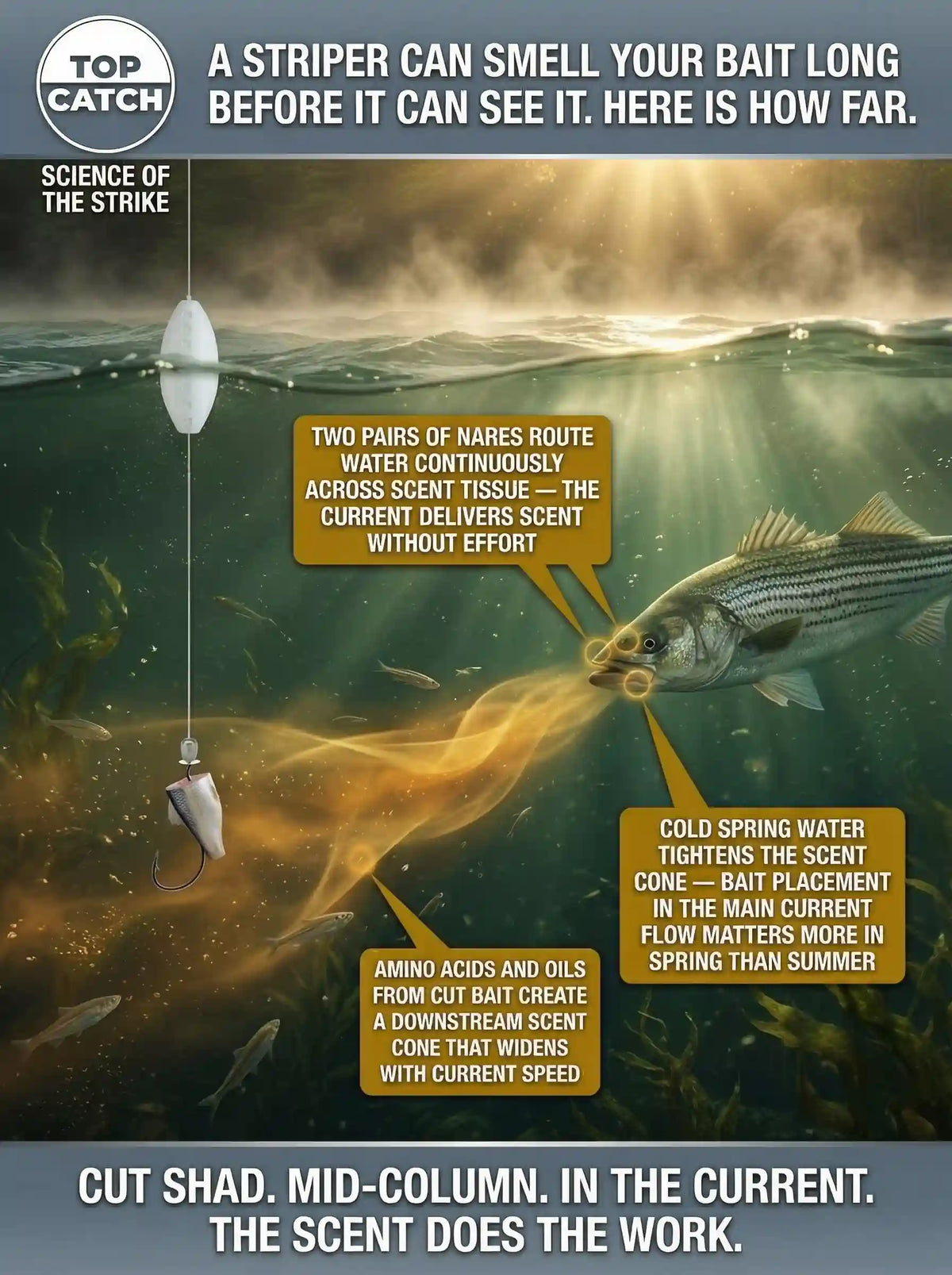
How Far Away Can a Striped Bass Smell Bait?: The FATKAT Scent Strategy
Striped bass have an incredible sense of smell. They can find tiny bits of bait in a massive amount of water. Imagine dropping one single drop of scent into an Olympic-sized swimming pool—a striper could still find it.
They don't breathe through their noses like we do. Instead, the river current pushes water through their nostrils and over special sensors. The current does the work for them.
How a Striper's Nose Actually Works — and What It's Looking For in the Water ▼
Unlike humans, a striped bass doesn't smell through breathing.
In moving current, bait releases a downstream scent cone. Dissolved oils, amino acids, and biological compounds spread in a widening plume that a striper can detect and actively track upstream toward the source. The stronger the current, the faster that plume travels — and the wider the detection zone.
Cut shad and river herring are particularly effective because they release the amino acid and oil profiles that stripers have evolved to recognize as high-value prey. The scent profile of a stunned, dying shad — leaking oils and amino acids into the current — is the exact chemical signal a pre-spawn striper's olfactory system is tuned to respond to.
Unlike the catfish — which has taste receptor tissue distributed across its entire body surface and barbels, giving it near whole-body chemical detection — the striper's olfactory system is concentrated in the nares and processed through a dedicated brain structure called the olfactory bulb. It is a distance sensing system, not a contact system. The contact sense comes next.
A drift rig, like the FATKAT Drift Rig, holds bait off the bottom and mid-column — directly in the current that carries the scent plume downstream. A bait on the substrate is largely removed from that flow. Its scent dispersal is suppressed. Its detection range shrinks dramatically.
→ How does the shad run trigger the striper feeding window? — [2026 Shad Run Guide]
→ How the catfish olfactory system compares — and where the two species diverge

Why a Striped Bass That Mouths Your Bait and Spits It Out Isn't Making a Mistake — It's Making a Decision Based on Chemistry
The fish that "mouths" your bait and spits it out isn't making a mistake—it’s making a decision. Striped bass have taste buds on the outside of their lips.
They can taste your bait before it even enters their mouth. This is why fresh-cut bait is so much better than plastic. Plastic doesn't have the natural oils that a striper’s lips are tuned to detect.
Why Stripers Spit Artificial Baits — The Biology of the Lip-Drop ▼
Have you ever had a fish "mouth" your bait and then spit it out before you could set the hook? That isn't a mistake. The fish is making a choice.
Striped bass taste buds are concentrated in and around the mouth and outer lips — a contact-range confirmation system that fires in the final moment of the strike.
Here's the sequence:
- scent draws the fish in from distance.
- The lateral line guides the final approach.
- Vision may confirm the silhouette.
- Then — in the moment the fish closes on the bait — the taste receptors on its lips fire.
- If the chemical profile matches the expected prey signal, the fish commits fully. If it doesn't, the fish drops the bait before it's inside the mouth.
This is the biology behind the "lip drop" — the maddening experience of watching a striper mouth your bait and release it without a hookup. It's not a timing problem. It's a chemistry problem. The bait passed every other sensory test and failed the final one.
This is where cut natural bait has an insurmountable advantage over artificial presentations — not just at the scent stage, but at the taste confirmation stage. A piece of fresh-cut shad delivers the correct amino acid and oil profile at both ranges. A plastic swimbait, regardless of scent additive, cannot fully replicate the dissolved biological compounds a striper's lip receptors are reading.
Unlike a catfish — whose taste receptors extend across its entire body surface allowing it to detect and confirm prey by brushing against it — a striper's taste sense is concentrated at the mouth. It is a close-range final-confirmation system. But it is extremely sensitive, and it is the last gate your bait has to pass through before the hook is set.
Why a Striped Bass 80 Feet Away Feels Your Bait Moving Before It Smells It — and What That Means for Your Presentation
Before a striper smells your bait, it may have already felt it. Striped bass have an inner ear that detects pressure waves from far away. This is their "early warning system." A bait tumbling naturally in the current sends out a low-frequency pulse that tells the fish something worth eating is nearby.
This far-field vibration system is the first alert that something worth investigating is nearby.
The Inner Ear Explained: How Stripers Sense Prey From 50+ Feet Away ▼
Fish hearing works differently from ours, but the underlying mechanics are similar. The striped bass inner ear detects pressure fluctuations at frequencies above 100Hz — the far-field acoustic waves that travel long distances through water before fading.
A struggling baitfish, a chunk of cut shad tumbling in current, or a bait oscillating on a drift rig all produce pressure waves. The inner ear picks these up and alerts the fish that something is in the area. But — and this is critical — the inner ear cannot determine the precise direction of the sound source. It only registers that a signal is present.
This is where the lateral line takes over.
Research on the combined octavolateralis system confirms that inner ear (high-frequency, far-field) and lateral line (low-frequency, near-field) work as a two-stage detection relay. The inner ear triggers investigation. The lateral line guides the approach.
A bait drifting at current speed produces the low-intensity, irregular vibration profile of a struggling or stunned prey item. A fast-retrieved lure produces high-intensity, regular mechanical vibration that doesn't match the natural prey profile a striper is tuned to — and in some cases may read as a threat rather than an opportunity.


Why the Line Running Down a Striper's Side Is More Useful at 10 Feet Than Its Eyes Are — and What That Means for Bottom Rigs
The faint line running from a striper's gills to its tail is like a row of tiny ears that feel movement.
It guides their final approach. In muddy water, this is their most important tool. A bait that tumbles and pulses in the flow creates exactly the pattern a striper's lateral line is tuned to find.
Neuromasts, Hair Cells, and Pressure Gradients: The Close-Range Sense That Seals the Strike ▼
If you look at the side of a striped bass, you will see a faint line running from its gills to its tail. This is the "lateral line." It works like a row of tiny ears that feel pressure.
It allows the fish to feel "vibrations" in the water. In a muddy river where they can't see, this sense becomes their primary tool. They can feel the exact wake left behind by a struggling baitfish. A bait that tumbles and pulses in the current sends out a "help" signal that the striper feels through its skin.
These cells respond to the smallest displacement of water — pressure changes created by a moving prey item, a struggling baitfish, or even the wake left behind by something that passed through seconds earlier.
Research distinguishes two types of neuromasts:
- Superficial neuromasts detect flow velocity and direction — they tell the fish which way the disturbance is moving.
- Canal neuromasts detect pressure differentials — they respond specifically to the nonuniform flow created by a vibrating or struggling prey item, filtering out the background noise of steady current.
This filtering ability is critical in fast tidal rivers. The lateral line doesn't simply detect all vibration — it detects changes in the flow pattern against the background of the current. A bait drifting at exactly river speed creates very little differential signal. A bait oscillating, tumbling, or pulsing as it moves — as cut bait naturally does — creates exactly the nonuniform pressure pattern that canal neuromasts are tuned to detect.
Blinded predatory fish can hunt successfully using lateral line alone. Research confirms that only when lateral line function is chemically blocked do blinded predators lose the ability to hunt effectively. The lateral line is not a backup sense — in low visibility conditions, it becomes the primary targeting system.
Catfish have denser superficial neuromasts than stripers — an evolutionary adaptation to muddy, low-current environments where close-range detection is prioritized. Stripers have a more balanced system, with both canal and superficial neuromasts well-developed — optimized for open-water pursuit and current-environment hunting across a wider detection range.
A drift rig, like the FATKAT Drift Rig, suspends bait mid-column where water displacement is maximum and unobstructed.
→ How the catfish lateral line differs — built for mud, not open water
→ [Drift Fishing for Stripers] — why mid-column presentation maximizes lateral line detection - COMING SOON

Why the Eyes That Work Perfectly in Clear Ocean Water Become Almost Useless in the Muddy Tidal Rivers Where Stripers Spawn
Striped bass have good eyes, but they are built for clear water. In a muddy river, they struggle.
Unlike humans, a striper cannot change its focus—they are naturally nearsighted. In dark water, they can usually only see things a few feet away. This is why scent and vibration are much more important for spring fishing.
What the Research Says About Striper Vision — and Why Turbid Water Changes Everything ▼
A 2010 study published in the Journal of Experimental Biology examined visual function in four Chesapeake Bay piscivores, including striped bass. The finding relevant to every tidal river angler: striped bass visual systems "require bright light for optimal function" and are "frequently disadvantaged" in turbid, coastal water conditions.
The striped bass eye contains both rod cells (low-light sensitivity) and cone cells (color vision) in proportions similar to human vision. However — and this is the critical distinction confirmed by researchers at Stockton University — the striped bass eye lens is NOT adjustable. Unlike human eyes, which continuously focus at varying distances, the striper's lens is fixed. This makes them effectively near-sighted beyond a few feet in the best conditions.
In clear, bright water this limitation is partially offset by their cones' color sensitivity and their ability to detect contrast well at close range. In stained, turbid spring river water — where light is both absorbed and scattered before reaching significant depth — their visual advantage shrinks to the range of a few feet at most.
This is not a weakness — it is an evolutionary trade-off. Stripers evolved in estuarine environments where turbidity is common and scent and lateral line detection carry more prey-location weight. Their visual system is tuned for close-range confirmation, not long-range target acquisition.
The practical implication: a flashy lure depending on visual triggering from 10 or 20 feet away in spring tidal current is fishing to a sense that isn't working well. A bait that produces scent and vibration — detectable from far greater distance in those conditions — is fishing to the senses that are.
-> How shad react differently from stripers — and what that means for presentation on the same river
For how these sensory systems perform under real 2026 tidal river conditions — water temperatures, turbidity levels, and migration timing river by river — see our striped bass spring run guide.
Why Do Striped Bass Strike Upward?: The Mid-Column Strike Zone
A striper’s eyes are angled toward the top of its head. They are programmed to look up. They like to sit deep and look toward the surface, watching for the dark silhouette of a baitfish against the light of the sky.
If your bait is sitting on the bottom in the mud, it’s in the one spot a striper isn't looking.
The Upward Hunter: Why Suspended Bait Creates a Perfect Silhouette Target ▼
Look at where a striper’s eyes are—they are angled toward the top of their head. This is because they are programmed to look up.
They like to sit deep and look toward the surface. When a bait drifts above them, it creates a dark silhouette against the light from the sky. This makes the bait very easy to see. If your bait is sitting on the bottom in the mud, the fish is less likely to notice it. To "Master the Biology," you have to keep your bait floating in that middle zone where the fish are looking.
Their eye placement gives them a wider field of view toward the surface than toward the substrate. Combined with their close-range visual acuity, this creates a hunting orientation that prioritizes prey silhouetted against the light above.
A bait positioned mid-column or near the surface creates exactly this silhouette profile — a dark shape backlit against the brighter surface light, providing the visual contrast a striper uses for final strike targeting. A bait on the substrate provides no upward silhouette. It sits in the darkest, most visually confusing zone in the water column, from the striper's perspective.
Research on striped bass feeding behavior confirms they are crepuscular hunters — most active at dawn and dusk. This timing is not accidental. At light transitions, striped bass eyes adapt faster than the baitfish they prey on. In the minutes after dawn breaks, or as light fades at dusk, stripers have a temporary visual advantage that makes hunting more efficient.
This is the biological explanation for why early morning and late evening produce the most consistent action during the spring run — not just angler tradition, but documented prey-predator light-adaptation dynamics.
The silhouette advantage also explains why overcast days can produce excellent striper fishing despite low light. Diffuse cloud cover reduces surface glare and creates consistent mid-column contrast — actually improving the silhouette profile of suspended bait compared to direct bright sunlight.
A drift rig, like the FATKAT Drift Rig, keeps bait suspended and drifting mid-column — directly in the visual strike zone of an upward-oriented hunter. The alternative — a bait anchored to the bottom — is positioned in the one zone a striper's anatomy is least optimized to strike from.
-> How the bobber fishing technique keeps bait in the mid-column strike zone


How Does River Current Change the Way Stripers Hunt?: Using the Flow
Everything we've covered about scent, vibration, and sight works differently in moving water. Current isn't just a backdrop — it actively reshapes every sense a striper uses to find food.
Understanding how is the difference between presenting bait where the biology works and presenting it where it doesn't.
Current as a Sensory Force: How Moving Water Reshapes Scent, Vibration, and Sight Detection ▼
Current and scent:
In still water, scent disperses in all directions equally — a sphere of diminishing concentration. In moving current, scent disperses in a downstream cone. This actually increases detection efficiency in one direction — a striper holding and facing upstream in a current seam has a continuous, undiluted scent stream delivered directly to its nares. The current does the work of carrying scent to the fish. Bait positioned upstream of a holding striper is delivering scent exactly where the fish's olfactory system is optimized to receive it.
Current and vibration:
Background current creates a constant low-level vibration signal that the lateral line filters as noise. A bait moving with the current at river speed creates very little additional differential signal — it blends into the background. But a bait that oscillates, tumbles, or pulses as it drifts creates exactly the nonuniform pressure pattern that canal neuromasts distinguish from background current. This is why cut bait tumbling naturally in current is more detectable than a rigid artificial moving at the same speed.
Current and vision:
Moving water scatters and absorbs light. Turbidity increases with current speed as sediment is suspended. The faster and murkier the water, the shorter the striper's effective visual range — sometimes to just a few feet. This progressively shifts the hunting burden to scent and lateral line as current speed and turbidity increase. In the high-flow, high-turbidity conditions of spring tidal rivers, vision may be the least useful of the three primary hunting senses.
The current seam advantage:
A striper holding at the edge of a current seam — where fast water meets slow — has simultaneous access to a scent stream from upstream, lateral line detection across the seam face, and visual confirmation range into the slower water. This is why current seams are the highest-percentage positions in the entire river. They allow all three senses to operate simultaneously at maximum efficiency. This is why using a drift rig, like the FATKAT drift rig is so lethal.
For the full East Coast spring fishing run overview covering all species and timing, see our east coast spring fishing run guide.
Does Water Temperature Affect How Well Stripers Smell?: The Cold Water Truth
Temperature doesn't just affect where stripers are. It affects how well they can smell, how active their lateral line is, and how efficiently their visual system operates.
Cold spring water changes the entire sensory equation — and most anglers have no idea it's happening.
Cold Water, Suppressed Scent, and Why Presentation Matters More in Spring Than Summer ▼
Water temperature affects scent dispersal in a direct, measurable way. Cold water is denser and more viscous than warm water — this slows the diffusion of dissolved molecules, including the amino acids and oils released by cut bait. The scent plume from a piece of cut shad in 45°F spring water is shorter and narrower than the same bait in 65°F summer water.
This means two things for the spring angler:
First, bait placement relative to the holding fish matters more in cold water than in warm. The scent cone is tighter. Fish need to be closer to the downstream scent corridor to detect it.
Second, bait presentation needs to maximize scent dispersion — mid-column in the main current flow, not on the substrate where cold, dense water pools with minimal movement.
Cold water also affects striper metabolism broadly. Pre-spawn fish at 48-52°F are physiologically suppressed compared to their summer state — slower reaction times, reduced willingness to chase, heightened sensitivity to energy expenditure. Every aspect of their feeding behavior at this temperature reinforces the case for a naturally drifting, low-effort, scent-heavy presentation.
As water warms through the pre-spawn range (48–58°F), scent dispersal increases, metabolic activity rises, and feeding windows lengthen. The 55–62°F window is often the most productive of the season precisely because it balances scent dispersal efficiency with metabolic activity — fish are warm enough to feed actively, but not yet focused on spawning.
→ Temperature triggers by phase — [Why Do Striped Bass Stop Biting Mid-Run?]
→ USGS Water Temperature Gauges— real-time river temperatures for your section


How Does a Striper Decide to Strike?: The Four-Step Feeding Process
Each sense we've covered fires at a different range and triggers a different behavioral response. Together they form a four-stage sequence — from first alert to final strike.
Understanding this sequence is what separates anglers who occasionally catch stripers from anglers who catch them consistently.
The Four-Stage Strike Sequence: From First Scent Detection to the Hook Set ▼
Stage 1 — Far-field alert (50+ feet):
The inner ear detects pressure waves from a tumbling, oscillating bait. The fish registers that something is in the area. No direction yet — just presence. The fish becomes alert.
Stage 2 — Scent orientation (variable distance, current-dependent):
The olfactory system picks up the downstream scent plume. Dissolved amino acids and oils give the fish directional information — the source is upstream, in the current. The fish orients and begins moving toward the scent corridor.
Stage 3 — Lateral line targeting (within 5-10 body lengths):
Canal neuromasts detect the nonuniform pressure pattern of the tumbling, pulsing bait. The fish locks onto the exact position and trajectory of the target. This is the commitment phase — the fish accelerates toward the bait.
Stage 4 — Visual and taste confirmation (within striking distance):
Vision confirms the silhouette against the surface light. The fish positions for the strike upward into the bait's trajectory. Lip taste receptors fire on contact — if the chemical profile matches, the strike is completed. If not, the fish drops the bait.
Every stage of this sequence is optimized by a naturally drifting, mid-column, scented presentation. The far-field vibration is produced by the bait's natural tumbling motion. The scent corridor is delivered downstream by the current. The lateral line is engaged by the bait's nonuniform movement against the current background. The visual silhouette is created by the bait's mid-column position against the surface light. The taste confirmation is delivered by the natural amino acid profile of cut bait.
A drift rig, like the FATKAT Drift Rig, is the only presentation that addresses all four stages simultaneously without asking the angler to do anything except let the river work.
What Rig Triggers All of a Striper's Senses at Once?: The FATKAT Drift Rig
Most fishing presentations trigger one or two of a striper's hunting senses.
The best presentation triggers all four — in the right sequence, at the right range, at the right speed. The biology has a clear answer for what that presentation looks like.
For how these four senses change across the full annual cycle — from pre-spawn staging through post-spawn recovery to the fall migration — see our striped bass feeding behavior and seasonal guide.
The Presentation Checklist: What Scent, Vibration, Silhouette, and Taste Demand From Your Rig ▼
Working backward from the biology:
Taste demands: Natural cut bait. Fresh amino acid and oil profile. No artificial substitute fully passes this gate.
Silhouette demands: Mid-column positioning. Bait suspended between surface and substrate, backlit against surface light. Not on the bottom.
Lateral line demands: Natural, nonuniform movement. A bait that tumbles, pulses, and oscillates as it drifts — not a rigid artificial moving mechanically. Drift speed matching current speed — any faster and the differential signal reads wrong.
Scent demands: Mid-column in main current flow. Maximum scent dispersal downstream into the holding zone. Not on the substrate where flow is reduced.
Inner ear demands: Low-frequency oscillation — the 1-80Hz range produced by a naturally tumbling bait. Not the high-frequency mechanical vibration of a fast-retrieved hard lure.
A drift rig, like the FATKAT Drift Rig, addresses every item on this checklist by design. The sliding weight keeps bait suspended. The leader allows natural bait movement. The mid-column position maximizes both scent dispersal and silhouette profile. The natural drift at current speed produces exactly the vibration signature the striper's lateral line and inner ear are tuned to detect.
The further upstream you fish — the colder, more turbid, and faster the water — the more each of these sensory demands tightens. Near the fall line, every other presentation is working against the biology. A natural drift with cut bait is the only presentation that works with all of it.
→ [Striped Bass Feeding Behaviors] — full tactical application
→ [Spring Striper Run Guide] — timing your presentation to the run


Mastering the Biology: The Science of the Strike
Every sense a striped bass has—scent, taste, vibration, and sight—has a specific biological "demand." When you stack those demands together, they point to one way to fish.
Master the Biology: Protect the Ecology ▼
Master the Biology:
A pre-spawn striper in a fast river is looking for a "low-effort" meal. They want something that smells like a dying shad and moves like a struggling baitfish. If your rig is sitting heavy on the bottom, you are missing three out of the four sensory triggers.
To trigger a strike, your bait must:
- Stay in the Flow: This carries your scent downstream to the fish.
- Tumble Naturally: This creates the vibration pattern their lateral line is looking for.
- Create a Silhouette: This lets the fish see the bait against the surface light.
Protect the Ecology:
Part of being a master angler is ensuring the fishery stays healthy for the next generation. That is the "Science of the Strike" in action. By using lead-free weights and in-line circle hooks, we align our gear with the biology to catch fish effectively while making sure they can be released safely.
Why Use Circle Hooks for Stripers?: Protecting the Ecology
Using circle hooks isn't just about following the law; it's a biological advantage. Because striped bass have taste receptors on their outer lips, they often "mouth" the bait before committing.
An in-line circle hook is designed to slide to the corner of the mouth as the fish turns to swim away. This prevents "gut hooking" and ensures a solid hook-up in the strongest part of the jaw. By choosing circle hooks, you are choosing to Master the Biology and Protect the Ecology at the same time.

FAQ: Striped Bass Sensory Biology
Yes. While not as extreme as a catfish, stripers have a dedicated scent-reading system that works continuously.
They are highly tuned to the specific oils released by prey like shad and herring.
Yes. While not as extreme as a catfish, in a strong river current, a "scent plume" can travel hundreds of yards downstream. A striper will pick up this trail and swim upstream to find the source.
Research confirms the lateral line detects low-frequency particle acceleration below 100Hz — specifically the near-field pressure changes created by a struggling or tumbling prey item.
The inner ear handles higher frequencies above 100Hz, providing far-field detection. Together they form the octavolateralis system — a two-stage prey detection relay that operates from long distance down to the moment of the strike.
No. Striped bass have both rod cells and cone cells in their retinas — rods for low-light sensitivity and cones for color detection in brighter conditions.
However research confirms their lens is fixed and non-adjustable, making them effectively near-sighted beyond a few feet. In turbid spring water, color becomes largely irrelevant — scent and vibration carry almost all of the prey-detection workload.
Stripers are "crepuscular," meaning their eyes adapt to changing light faster than the baitfish they hunt. At dawn and dusk, they have a temporary visual advantage over their prey.
At light transition periods, striper eyes adapt faster than the baitfish they prey on. This gives them a temporary visual advantage that makes hunting more efficient. Combined with the scent and lateral line advantages of low-light, high-contrast conditions, these windows consistently produce the most aggressive feeding behavior.
Yes — and this is one of the most important facts for presentation. Research confirms striped bass have taste buds on their outer lips, meaning taste confirmation happens before the bait is fully inside the mouth.
If the chemical profile of the bait doesn't match the expected prey signal, the fish drops it before the hook is set. This is the biology behind the "lip drop" — and it explains why fresh natural bait consistently outperforms artificials at the final stage of the strike sequence.
Current reshapes every sense. Scent disperses in a downstream cone rather than a sphere — increasing detection efficiency for fish holding and facing upstream.
Lateral line canal neuromasts filter background current as noise but lock onto the nonuniform pressure of a tumbling bait moving through that current. Vision is progressively suppressed as turbidity and current speed increase. The net effect in fast spring tidal rivers is that scent and vibration carry almost all prey-detection weight — which is exactly why natural drift presentations with cut bait consistently outperform visual lures in those conditions.
Spring Fishing Foundations
Spring Fishing in Freshwater Rivers
Spring fishing follows clear seasonal patterns as water warms and fish begin to move. This guide explains how spring changes river behavior across species and why timing matters more than technique.
Resident Species vs Migratory Fish
Spring Catfish Fishing: When Resident Fish Wake Up
Unlike striped bass, catfish do not migrate to spawn. Learn how warming water changes catfish behavior, feeding patterns, and where to find them during spring.
The Striper Spring Run
Where to Drift Your Bait for a Successful Spring
Spring is the best time to catch striped bass during their migratory run in tidal rivers on the east coast
Resources and Further Reading:
REFERENCE INTRO:
All biological and behavioral claims in this guide are supported by peer-reviewed research. DOI links take you directly to the original study.
REFERENCES:
Horodysky, A.Z., Brill, R.W., Fine, M.L., Musick, J.A., & Latour, R.J. (2008). Acoustic pressure and particle motion thresholds in six sciaenid fishes. Journal of Experimental Biology, 211, 1504–151110.1242/jeb.016196
Horodysky, A.Z., Brill, R.W., Warrant, E.J., Musick, J.A., & Latour, R.J. (2010). Comparative visual function in four piscivorous fishes inhabiting Chesapeake Bay. Journal of Experimental Biology, 213, 1751–176110.1242/jeb.0381173
Kasumyan, A.O., & Døving, K.B. (2003). Taste preferences in fishes. Fish and Fisheries, 4(4), 289–34710.1046/j.1467-2979.2003.00121.x4
Coombs, S., & Montgomery, J.C. (1999). The enigmatic lateral line system. In Comparative Hearing: Fish and Amphibians (pp. 319–362). Springer 10.1007/978-1-4612-0593-6_85
Liu, G., Gao, Z., & Bhatt, D. (2016). The lateral line system of fish: A review of its anatomy and function. Applied Bionics and Biomechanics 10.1155/2016/26139696
Popper, A.N., & Fay, R.R. (1993). Sound detection and processing by fish: critical review and major research questions. Brain, Behavior and Evolution, 41(1), 14–3810.1159/0001138217
Hara, T.J. (1994). The diversity of chemical stimulation in fish olfaction and gustation. Reviews in Fish Biology and Fisheries, 4(1), 1–3510.1007/BF000432598
Døving, K.B., & Stabell, O.B. (2003). Trails in open waters: sensory cues in salmon migration. In Sensory Processing in Aquatic Environments (pp. 39–52). Springer 10.1007/978-0-387-22628-6_39
Montgomery, J.C., Coombs, S., & Halstead, M. (1995). Biology of the mechanosensory lateral line in fishes. Reviews in Fish Biology and Fisheries, 5(4), 399–41610.1007/BF0110381310
Webb, J.F. (2014). Morphological diversity, development, and evolution of the mechanosensory lateral line system in fishes and aquatic amphibians. In The Lateral Line System (pp. 17–72). Springer www.doi.org/10.1007/2506_2013_6